
Methodology & Platform

The Winning Edge Due Diligence framework

Six DD areas. Four dimensions. Predefined markers and sub-markers, weighted by importance, rated on a 5-point scale and backed by documented evidence.

The WEDD Framework

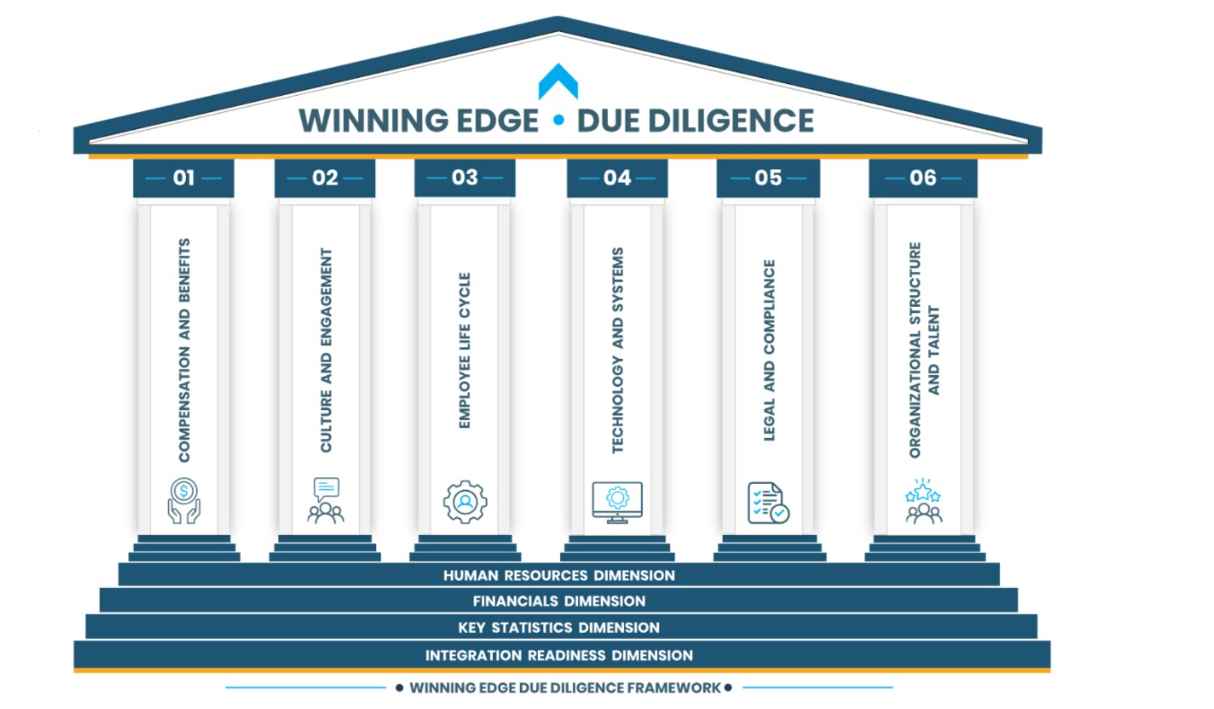
6 DD areas / pillars, examined through 4 dimensions

Our WEDD framework assesses the target through six DD areas: compensation and benefits, culture and engagement, employee life cycle, technology and systems, legal and compliance, and organizational structure and talent.

We examine each pillar through four dimensions:

Human Resources Risk

Rates the risk.

Financials Impact

Sizes the risk exposure or opportunity in value, nature and timing.

Key Statistics Compare

Sets out the metrics that can be compared with the acquirer.

Integration Readiness Effort

Measures the level of difficulty and ease of integration.

The Winning Edge Due Diligence framework: six pillars standing on four dimensions.

Robust and detailed

Each dimension is diligenced on a predefined, robust list of markers and sub-markers. Each DD area, marker and sub-marker in the framework is weighted on the basis of its importance and then rated on a 5-point scale by our DD analysts.

Weighted and traceable

Every rating is weighted and backed by documented evidence, so the findings can be traced. Together they give a consistent view of each pillar that informs the price, the deal protections and the integration plan.

6 DD areas / pillars by 4 dimensions

The 6 × 4 matrix

Every pillar is diligenced through every dimension.

DD area / pillar HR DimensionRisk Financials DimensionImpact Key Statistics DimensionCompare Integration DimensionEffort
1Compensation and Benefits●●●●
2Culture and Engagement●●●●
3Employee Life Cycle●●●●
4HR Technology and Systems●●●●
5Legal and Compliance●●●●
6Organizational Structure and Talent●●●●
What each dimension contains
  • Markers and sub-markers
  • Weighted
  • 5-point scale
  • Diligence with observations and data indicating risk levels
  • Markers and sub-markers
  • Risk and opportunity financial impact
  • Amount, actual and estimated
  • Nature and timing
  • Data points relevant for the deal, from target and acquirer
  • Diligence with data and relevant worksheets
  • Markers and sub-markers
  • Weighted
  • 5-point scale
  • Diligence with observations and data indicating effort and readiness for integration

Our WEDD framework is dynamic and can be customized for each deal.

How each dimension is assessed

The backbone of the due diligence

This process is the backbone of the due diligence, the executive dashboard analytics and the final WEDD report, applying the WEDD 4i flow.

1
Measures risk

HR Dimension

We apply the HR dimension to each of the six due diligence pillars. Each pillar is divided into predefined markers, and each marker into predefined sub-markers, all carrying a fixed weightage which is customized for each deal. This ensures that more material items count for more.

Our DD analysts rate every sub-marker on a five-point scale, where 1 is a critical risk and 5 is no risk. Each rating is supported by a documented observation, a recommendation and its evidence source. The ratings roll up into a weighted risk score for each marker and each pillar. A lower score means a higher risk.

The result: a clear view of the human resources processes, maturity level, compliance and overall culture within the target organization, with a weighted average risk score for each DD area / pillar.

2
Sizes impact

Financial Dimension

We assess the financial dimension through four markers:

  • Liability impact
  • Obligation impact
  • Restructuring impact
  • Harmonization impact

We review the sub-markers that apply to the target and classify each as a risk, an opportunity or neutral. Where a sub-marker has a financial effect, we estimate it as an absolute amount, an estimated amount or, where it cannot be reliably valued, as non-quantifiable. We record whether the impact is one-time or recurring and when it will fall, from Day 1 to three years. Each finding carries its observation and evidence.

The result: a clear view of financial opportunity and liability, and the mitigation options: holdback, value adjustment or provision.

3
Enables comparison

Key Statistics Dimension

We start with the key metrics that are relevant to the target and the deal, together with crucial comparable key statistics from the acquirer. We then use this data to understand compatibility, maturity and stability, along with integration readiness and mitigation plans.

Each metric is classed as applicable, not applicable or not available. Where a metric applies, we use the data provided or calculate it ourselves, and file the supporting calculations and observations with the report and dashboard. Every metric carries an observation and its evidence source, across both the due diligence assessment and integration readiness.

The result: a set of the target’s important metrics, ready to be diligenced, compared with the acquirer and assessed for integration and mitigation.

4
Measures effort

Integration Readiness Dimension

We apply integration readiness across the due diligence pillars using three markers of equal weight, each with three sub-markers:

  • Process alignment and compatibility
  • Integration complexity and change management
  • Integration effort and time for people and process

We rate every sub-marker from 1 to 5, where 1 signals a very challenging integration and 5 an easy one. For each rating we record the observation, a mitigation plan and the evidence source, and attach documentation where required. The ratings roll up into a weighted average integration score for each pillar, so that a higher score shows an easier integration.

The result: complete clarity on the level of ease and difficulty that the acquirer will face during integration, mapped individually for each of the six DD areas / pillars.

Our rating scales and bands

One five-point scale. A higher score is always better.

Both the HR and Integration Readiness dimensions use the same five-point scale. Each sub-marker is rated from 1 to 5, and the ratings are combined using their weightages into a weighted score between 1.0 and 5.0 for each marker and pillar.

The scale is split into five equal slices of 0.8, so each band covers the scores closest to one rating. In both dimensions, 5 is the favourable end.

HR Dimension

Measures risk

Weighted scoreBandRating
≥ 4.2No Risk5
3.4 – 4.19Low Risk4
2.6 – 3.39Moderate Risk3
1.8 – 2.59High Risk2
< 1.8Critical Risk1

Integration Readiness

Measures effort

Weighted scoreBandRating
≥ 4.2Integration Is Easy5
3.4 – 4.19Integration Is Fairly Easy4
2.6 – 3.39Integration Requires Moderate Effort3
1.8 – 2.59Integration Challenging2
< 1.8Integration Highly Challenging1

Weighted scores are rounded to two decimal places before the band is applied.

Methodology

The WEDD 4i Flow

We structure every finding through four sequential lenses, so that each observation moves from evidence to action.

identificationWhat do we know
interpretationWhat does it mean
implicationWhy does it matter
integrationWhat should we consider

Identification

We establish the facts from documents, data and stakeholder interviews, without judgement.

Interpretation

We read those facts against the organisation’s context, practices and relevant benchmarks to surface the underlying pattern or root cause.

Implication

We assess the consequence of each finding for the business in terms of risk, cost, compliance and people.

Integration

We translate the implications into prioritised considerations for the deal and for post-transaction planning.

The WEDD Platform

From sub-marker ratings to an executive dashboard and the WEDD report

The platform carries the methodology end to end: the framework is configured for the deal, analysts record ratings with their evidence, and the results roll up into executive dashboard analytics and the final WEDD report.

Configured for each deal

DD areas, markers, sub-markers and their weightages are set up for the specific transaction, so that more material items count for more.

Evidence behind every rating

Each rating carries its documented observation, recommendation or mitigation plan, and evidence source, so every finding can be traced.

Weighted scoring and bands

Sub-marker ratings roll up into weighted scores for each marker and pillar, and are placed into the HR and Integration Readiness bands.

Financial impact view

Risks and opportunities are recorded by amount, nature and timing, from Day 1 to three years, alongside mitigation options.

Executive dashboard analytics

A consistent view of each pillar across all four dimensions, with the target’s key statistics set against the acquirer’s.

The WEDD report

The final report presents every finding through the WEDD 4i flow: identification, interpretation, implication and integration.

Want to know more?

We would be glad to walk you through the WEDD framework.

Contact us